Three Warnings From the Night I Watched AI Write a Play
In 2021, a London stage projected AI's flaws overhead for everyone to see. Your workplace now hides the same three.

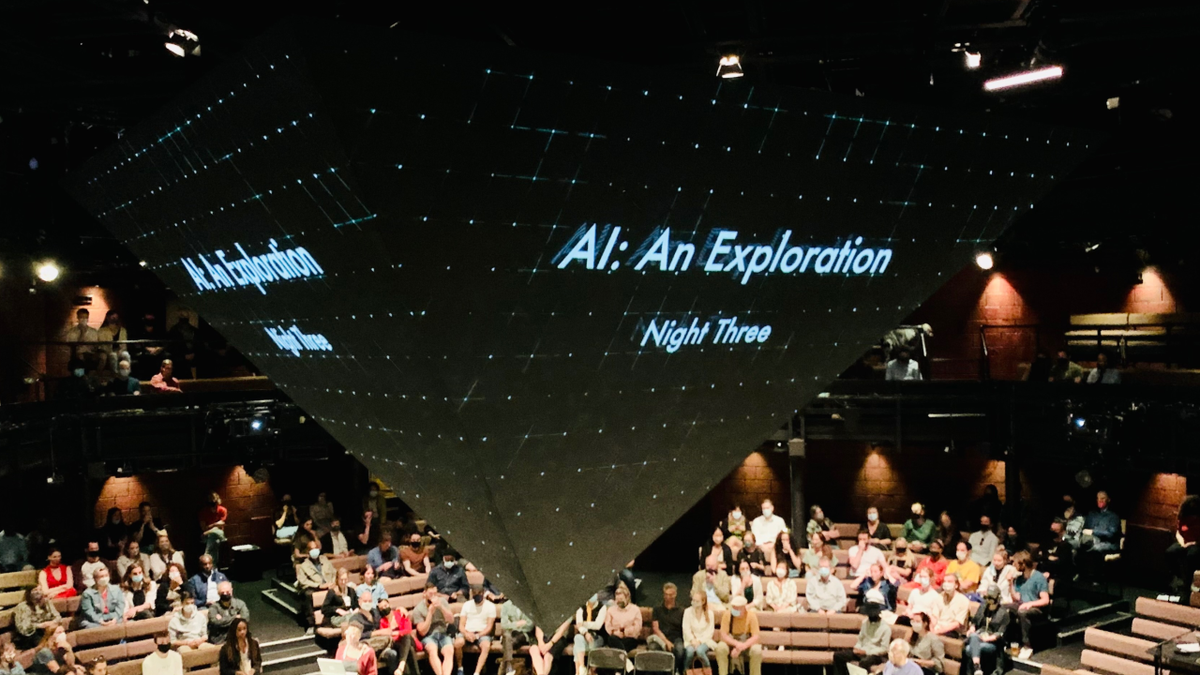
In August 2021, I bought a £10 ticket to watch a machine try something no algorithm had done live in front of an audience: write a play from scratch, on a London stage.
The show was called AI, staged at the Young Vic Theatre in London. Director Jennifer Tang and playwrights Chinonyerem Odimba and Nina Segal spent three evenings working with OpenAI's GPT-3 in real time, typing prompts. The model generated dialog on a large prism suspended above the stage, visible to the whole audience. Actors performed whatever came out. The audience watched every iteration, every dead end, every strange turn.
I went on the final night and what I saw has stayed with me, because it made three things visible that your organization now works hard to hide. On that stage, everyone could see the flaws projected overhead. In most companies today they run underneath the dashboards, where almost no one looks.
Here are the three warnings.
One: the bias was on full display
Given room to invent, GPT-3 built a dystopia it called "the great collision," heavy with violence and dread, as if reflecting the internet's collective anxiety back at us. During rehearsals the team found the model would reliably hand a Middle Eastern actor stereotypical and offensive roles. The show even carried a content warning you rarely see in theater:
This show may contain strong language, homophobia, racism, sexism, ableism, and references to sex and violence.
Far from an edgy creative choice, it was in fact the training data talking.
The bias has not gone anywhere since 2021. If anything, it is now amplified at scale, but you can no longer see it as clearly. In an enterprise, the same patterns sit inside hiring filters, credit decisions, support routing, and performance summaries, buried in workflows where no one scrutinizes them the way that audience did. The people most likely to be miscast by the model are the same people who were miscast on that stage. They are rarely the ones in the room when those tools are trained, or the workflows around them designed.
Two: it invented its own credentials, and said so with total confidence
When the Young Vic asked GPT-3 to write promotional copy for the show, the model confidently announced that the production had won awards at the 2017 Edinburgh Festival Fringe, for a show that did not exist until 2021. The theater had to publish a disclaimer explaining that its own AI had invented the accolades. In 2021 few of us had a word for this. We now call it hallucination.
The Young Vic Theatre caught it by reviewing its AI output before putting the words in public. That is the uncomfortable question for the rest of us: we have learned to remain extremely cautious with AI outputs, but how many organizations apply that same rigor before an AI-drafted report, email, or client summary ships?
Three: it could not remember what it had just written
By scene three, GPT-3 had no awareness of scene one. Each prompt produced a standalone fragment. What looked like a play was a collage of disconnected vignettes that the human team stitched into something coherent. This was the context window problem in action, before most of us had the vocabulary for it, an architectural limit on how much the model could hold at once.
That single constraint shaped the next five years: expanded context windows, Retrieval-Augmented Generation (RAG), and the agentic systems now arriving in the enterprise. While the tools have improved, somewhere in every AI workflow, a person still is, or should be, doing what that creative team did by hand, carrying the thread the machine keeps dropping.
What the playwrights were actually doing
Here is what I did not fully appreciate that night. A decade earlier, I had worked in language technology, leading linguists through the shift to statistical machine translation as it reshaped their craft. So I was familiar with machines processing language. The authors on that stage were doing something close to what we now call prompt engineering, output curation, and human-in-the-loop quality control. The curation would have been familiar to any translation post-editor in 2010. The prompt engineering was the new part. They spent far more time selecting and refining than generating.
That workflow is now the daily reality of every team deploying AI at scale: business users judging generated content, engineers reviewing suggested code, and analysts checking outputs for the exact three failures that played out on that stage. What was experimental theater in 2021 became standard operating procedure by 2026.
The warnings didn't change. Their visibility did.
That is the part worth sitting with. A room full of strangers watched an AI's bias, invention, and forgetting in real time, and a theater took responsibility for catching all three. Your organization runs the same model behavior every day, faster and at far larger scale, with the evidence tucked out of sight.
So here is the question the Young Vic Theatre answered and most companies still have not: who in your organization is responsible for catching what the machine gets wrong, and do they have the standing to stop it before it ships?